FPGA
5+ years of experience in FPGA development, mainly implementing cryptographic algorithms.Crypto
Degree in Information Technology with a specialization in Cryptology, 10+ years of experience in teams working on Crypto.Python
5+ years of experience in software implementations using Python.PM | Leadership
3+ years of experience working as Team Leader and Project Manager.PhD
Degree in Information and Communication Technology, obtained based on my work on logic synthesis and its application in FPGA-based electronic devices.R&D
Experience working in several projects concerning R&D solutions, e.g. the National Center for Research and Development projects.About Me
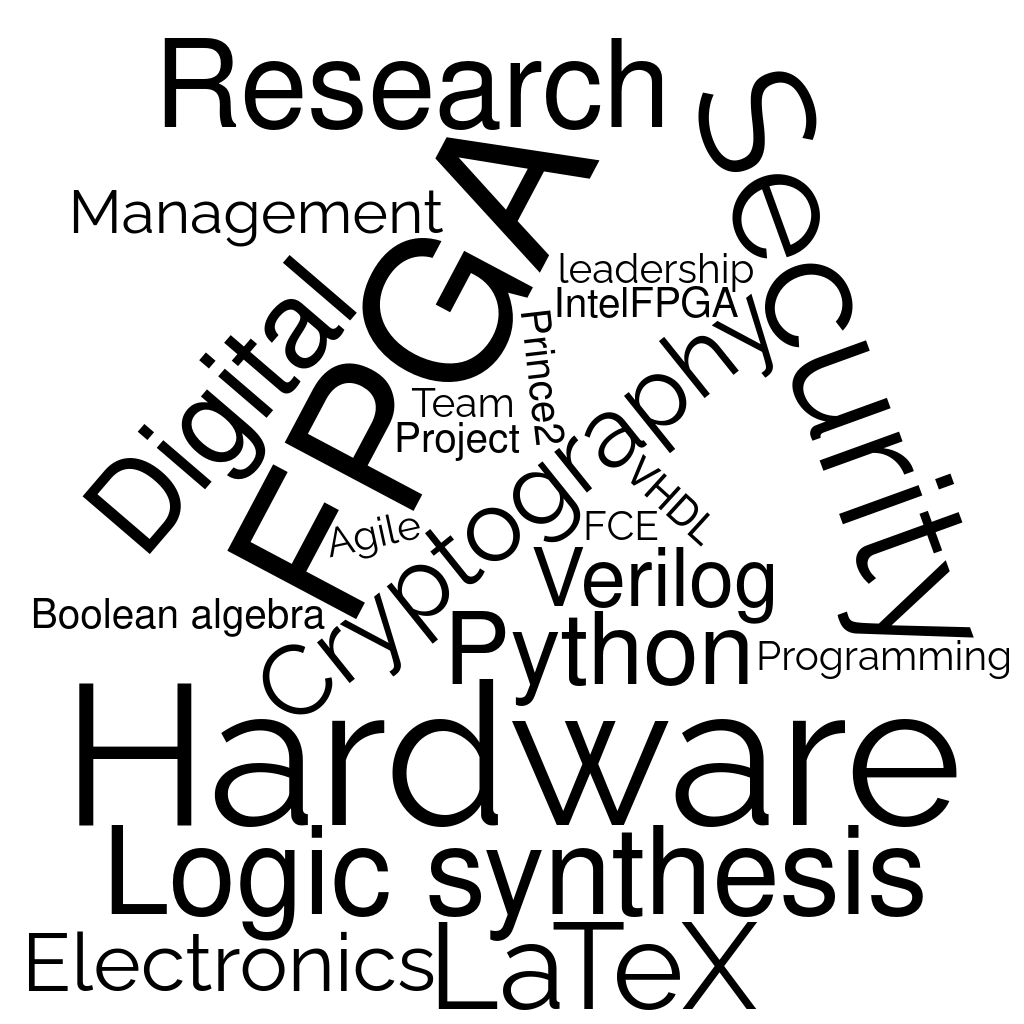
Area of expertise
Research
International conferences:
- Mazurkiewicz T., 2023. XOR-based decomposition and its application in memory-based and reversible logic synthesis, 18th Conference on Computer Science and Intelligence Systems (FedCSIS), Warsaw, Poland;- Mazurkiewicz T., 2022. Approximate memory-based logic synthesis of index generation functions using linear decomposition, 52nd IEEE International Symposium on Multiple-Valued Logic (ISMVL), Dallas, USA, pp. 145-150;
- Mazurkiewicz T., 2021. Reducing compound degree for optimum linear decomposition of symmetric Index Generation Function, 28th International Conference on Systems Engineering (ICSEng), Wrocław, Poland, p. 1-10;
- Mazurkiewicz T., 2020. On Heuristic Linear Decomposition of Symmetric Index Generation Functions, 36th International Business Information Management Association (IBIMA) Conference, Granada, Spain, p. 11011 - 11018;
- Mazurkiewicz T., 2020. Non-disjoint functional decomposition of index generation functions, 50th IEEE International Symposium on Multiple-Valued Logic (ISMVL), Miyazaki, Japan, p. 137-141;
- Mazurkiewicz T., 2019. Computationally efficient index generation unit using a Bloom filter, Photonics Application in Astronomy, Communications, Industry, and High-Energy Physics Experiments (Proceedings Volume), Proc. SPIE, Wilga, Poland, p. 111761L;
- Mazurkiewicz T. and Łuba T., 2019. Linear and non-linear decomposition of index generation functions, 26th International Conference on Mixed Design of Integrated Circuits and Systems (MIXDES), Rzeszów, Poland, p. 246-251;
- Mazurkiewicz T. and Łuba T., 2019. Non-disjoint decomposition using r-admissibility and graph coloring and its application in index generation functions minimization, 26th International Conference on Mixed Design of Integrated Circuits and Systems (MIXDES), Rzeszów, Poland, p. 252-256;
- Mazurkiewicz T., Borowik G. and Łuba T., 2018. Construction of index generation unit using probabilistic data structures, 26th International Conference on Systems Engineering (ICSEng), Sydney, Australia, p. 1-7.
Polish conferences:
- Mazurkiewicz T. and Łuba T., 2018. Metody wyboru dekompozycji dla algorytmu z wykorzystaniem zbiorów niezgodnosci i ich wpływ na minimalizację generatorów indeksów, Krajowe Sympozjum Telekomunikacji i Teleinformatyki (KSTiT), in: Przegląd Telekomunikacyjny - Wiadomości Telekomunikacyjne, 8-9, p. 722-725;- Mazurkiewicz T. and Łuba T., 2017. Redukcja Liczby Zmiennych do Reprezentacji Funkcji Generowania Indeksów, Krajowe Sympozjum Telekomunikacji i Teleinformatyki (KSTiT), w: Przegląd Telekomunikacyjny - Wiadomości Telekomunikacyjne, 8-9, p. 795-798.
Journals:
- Mazurkiewicz T., 2021. Synteza logiczna – aktualne trendy i perspektywy, Przegląd Telekomunikacyjny - Wiadomości Telekomunikacyjne, 3, s. 88-92;- Mazurkiewicz T., 2021. Heuristic Minimization of Symmetric Index Generation Functions utilizing their Properties, Journal of Software and Systems Development 2021;
- Mazurkiewicz T., 2020. Application of graph theory algorithms in the non-disjoint functional decomposition of specific Boolean functions, Journal of Telecommunications and Information Technology, p. 67-74, 3/2020;
- Mazurkiewicz T., 2019. Realizacja sprzętowego generatora indeksów z wykorzystaniem filtru Blooma, Przegląd Telekomunikacyjny - Wiadomości Telekomunikacyjne, 3, p. 61-66;
- Łuba T. and Mazurkiewicz T., 2019. Dekompozycja funkcjonalna w syntezie funkcji generowania indeksów, Przegląd Telekomunikacyjny - Wiadomości Telekomunikacyjne, 1, p. 19-25;
- Łuba T. and Mazurkiewicz T., 2018. Synteza generatorów indeksów metodami dekompozycji liniowej i funkcjonalnej, Przegląd Telekomunikacyjny - Wiadomości Telekomunikacyjne, 5, p. 122-128;
- Mazurkiewicz T., 2017. An efficient hardware implementation of a combinations generator, Technical Sciences / University of Warmia and Mazury in Olsztyn, 20(4), p. 405-413;
- Mazurkiewicz T. and Rawski M., 2016. Przegląd algorytmów kryptograficznych pod względem realizacji sprzętowego koprocesora do zastosowań mobilnych, Przegląd Telekomunikacyjny - Wiadomości Telekomunikacyjne, 11.
Chapters:
- Mazurkiewicz T. and Ferenc D., 2017. Aspekt bezpieczeństwa we współczesnych urządzeniach elektronicznych, Cywilizacja XXI w. - nowe rozwiązania technologiczne;- Mazurkiewicz T. and Ferenc D., 2016. Zastosowanie układów FPGA w kryptologii, Prace Seminarium Naukowego Instytutu Telekomunikacji Politechniki Warszawskiej. Działalność naukowa 2015/2016. Tom 2.
Others:
- Mazurkiewicz T., 2021. On memory-based logic synthesis of index generation functions.- Mazurkiewicz T., 2021. Synteza logiczna funkcji boolowskich szczególnej postaci, rozprawa doktorska.
- Mazurkiewicz T., 2020. Rozwiązania typu fault-tolerance w urządzeniach kryptograficznych wykorzystujących układy programowalne.
Details about all papers and full-texts of selected papers are available on Researchgate.